
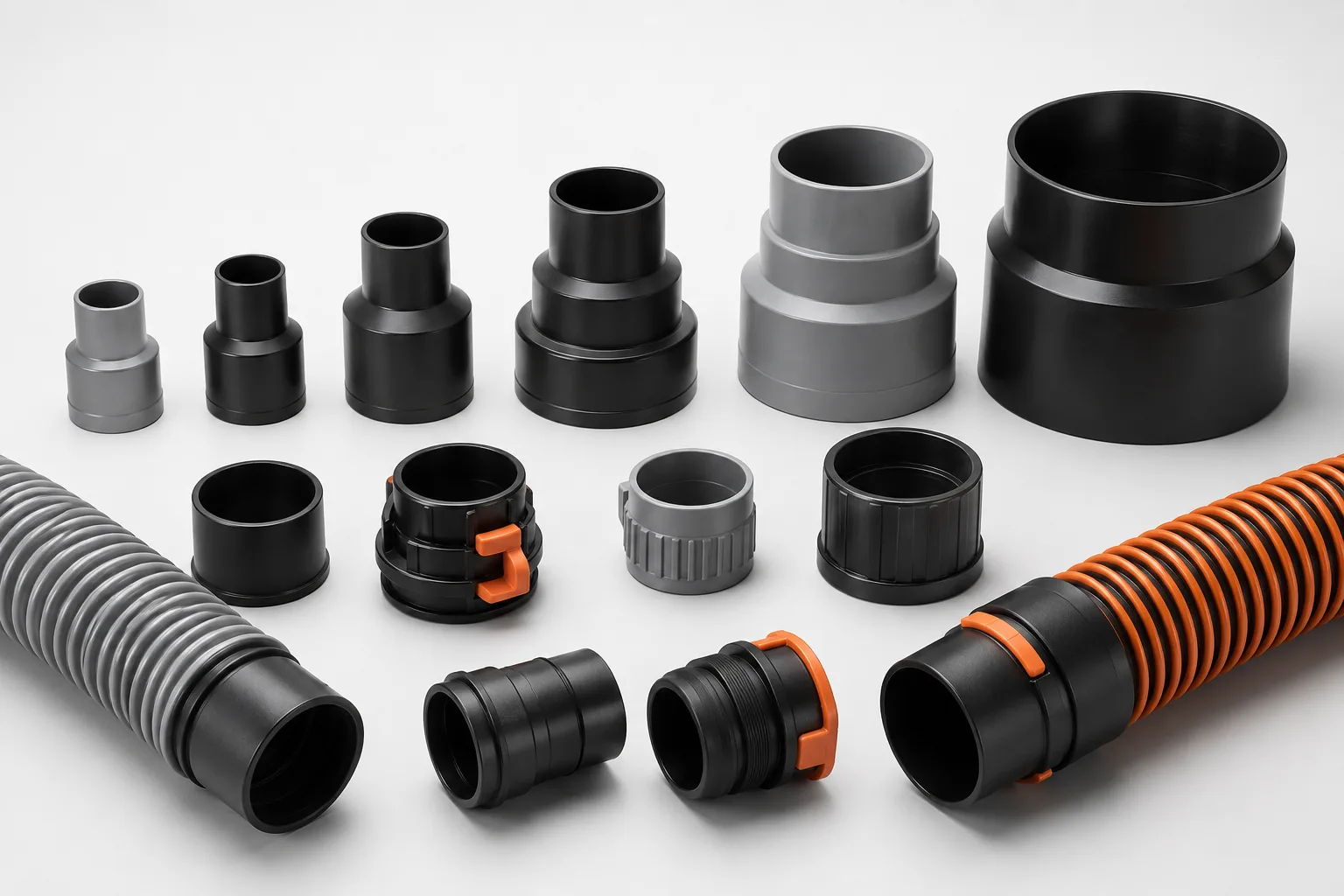
Common Sizes
1-1/4 in. is common on smaller accessories and some tool connections. 1-7/8 in. is common on compact and mid-size vacuums. 2-1/2 in. is widely used on larger vacuums and higher-volume cleanup applications.
RIDGID clearly shows that a 1-7/8 in. hose can be supplied with multiple 2-1/2 in. adapters. The size printed on the hose is therefore not necessarily the dimension of the fitting that mates with the tool.
How to Measure
Measure the OD of a male port, the ID of a female cuff and usable insertion depth. If the fitting is tapered, measure at more than one point. Calipers are preferable to a ruler.
Size and Airflow
A larger diameter provides more cross-sectional area for moving air and chips, but actual performance also depends on the vacuum, hose length, bends, filters and leaks. The practical choice is therefore the largest diameter the tool and vacuum can use correctly without creating an unstable connection.
Frequently Asked Questions
What is the most common shop-vacuum hose size?
There is no single universal size. 1-1/4, 1-7/8 and 2-1/2 in. are all common depending on vacuum capacity and use.
Is hose size the same as cuff size?
Not necessarily. Manufacturers can use adapters and cuffs whose real dimensions differ from the hose nominal diameter.
How do I know if my hose fits directly?
Check the actual ID/OD, male/female geometry, taper and insertion depth.
Technical Sources
The sizes and part references in this guide are based on the following official pages: RIDGID 1-7/8 in. hose RIDGID 2-1/2 in. hose.
Disconnect the machine before measuring or installing a fitting. Check the manufacturer manual, keep guards in place and never force a connector whose geometry does not match.