
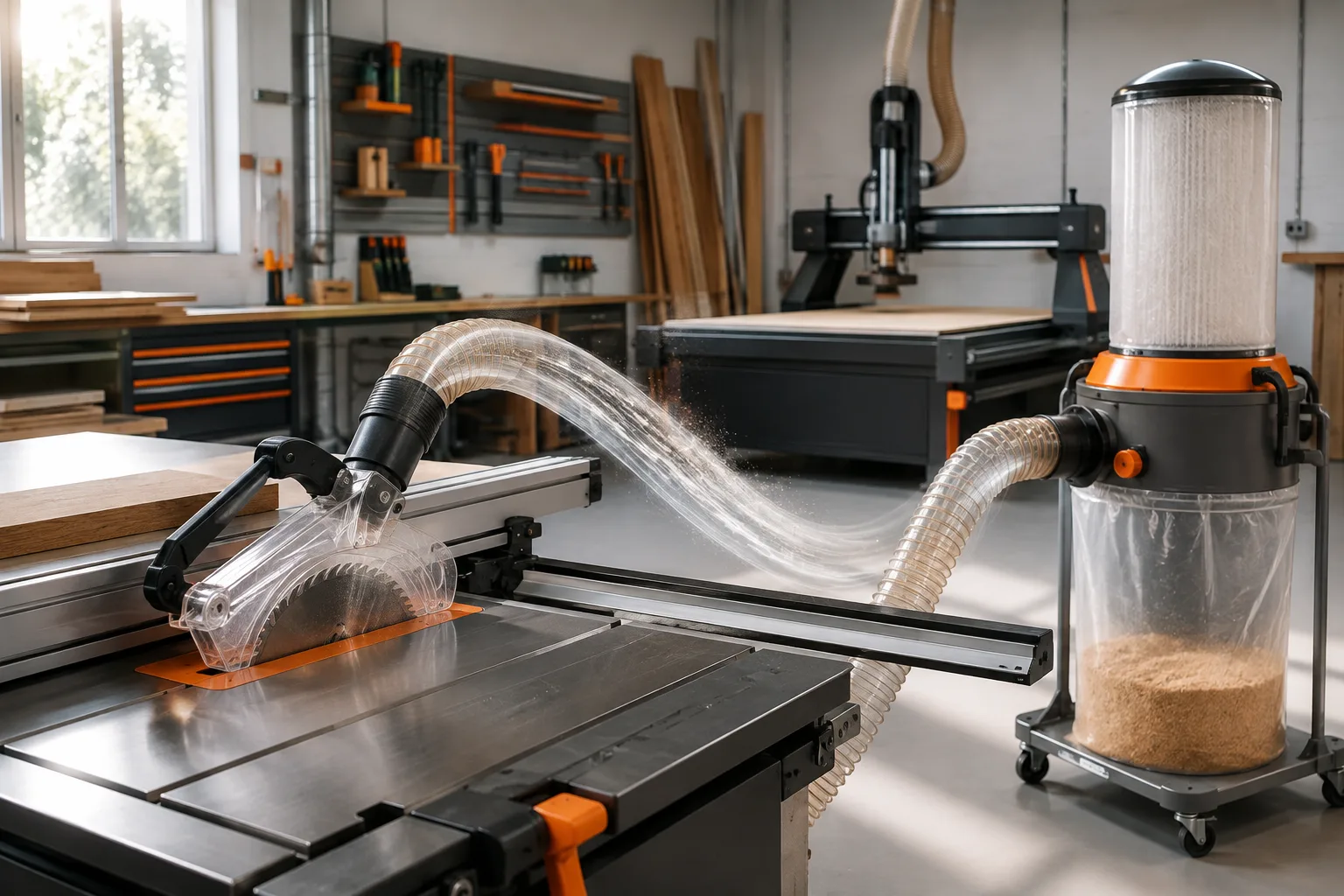
How a Quick Connect Works
The principle is simple: an adapter remains on the hose while a fitting or cuff remains on each tool. The hose clicks or locks onto the selected fitting. Rockler describes this exact workflow for its Click-Connect/FlexiPort system.
What to Verify Before Buying
Verify the real tool-port diameter, flexible-cuff clamping range, hose compatibility with the quick-connect adapter and available clearance around the machine.
A proprietary system can be very convenient within its own ecosystem but harder to mix with other brands. MatchMyTools therefore needs to show the connection system, not just diameter.
When This System Makes Sense
It is especially useful when one shop vacuum moves between a saw, router, sander and planer. For a fixed 4 in. duct network with blast gates, a dedicated dust-collector architecture may make more sense.
Frequently Asked Questions
Does a quick connect improve suction?
Not automatically. Its main benefit is faster, repeatable connection; sealing and diameter still matter.
Can I mix multiple brands?
Only when dimensions and interfaces match or a verified intermediate adapter is used.
Should a fitting stay on every tool?
That is generally the point of a quick-connect system: the hose moves while the fittings stay on the tools.
Technical Sources
The sizes and part references in this guide are based on the following official pages: Rockler Click-Connect Rockler FlexiPort.
Disconnect the machine before measuring or installing a fitting. Check the manufacturer manual, keep guards in place and never force a connector whose geometry does not match.