
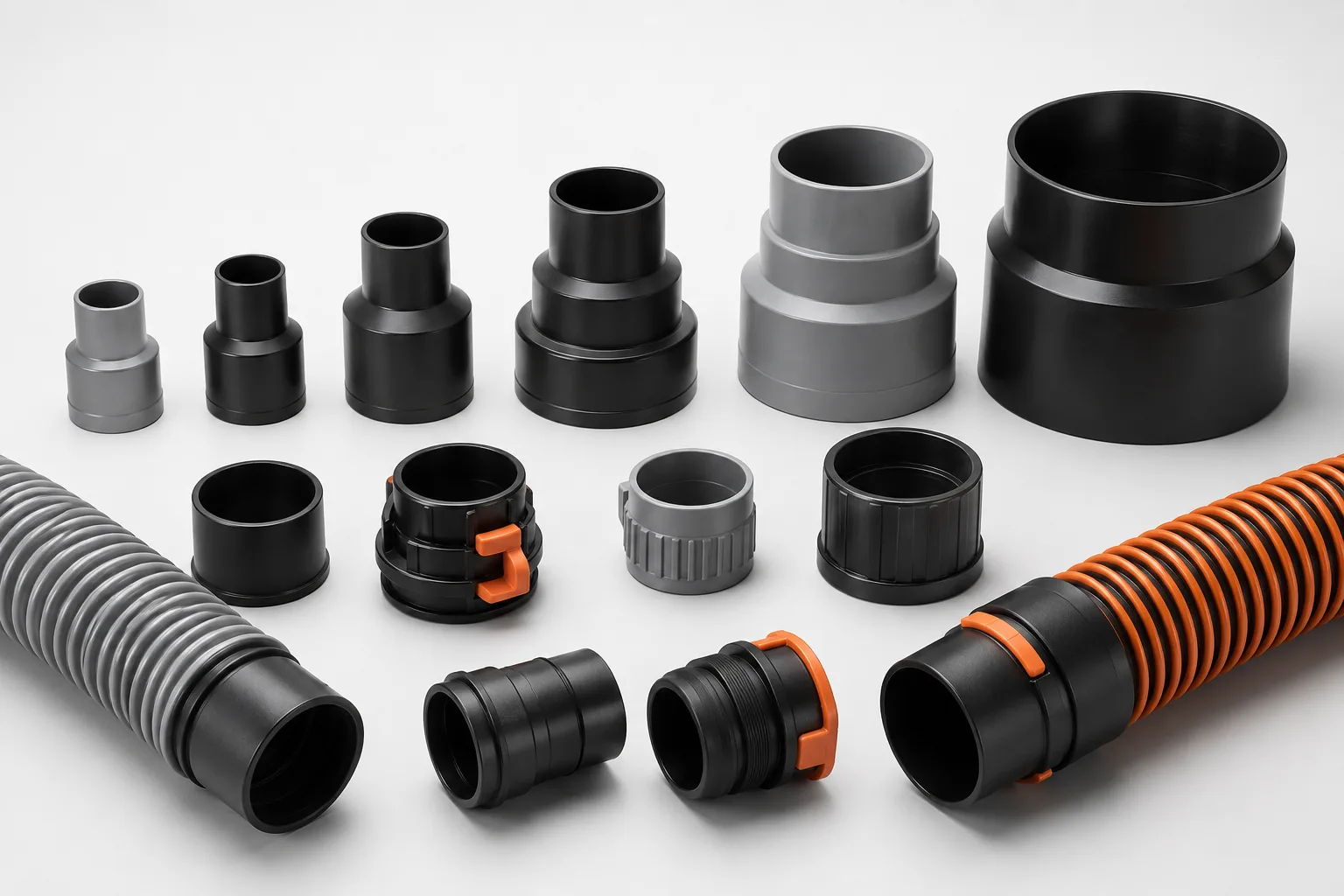
When to Choose a Universal Adapter
A universal fitting is useful for standard round ports with known ID/OD and when a flexible material can clamp securely. It is also practical in a mixed-brand workshop.
When to Choose a Tool-Specific Adapter
The Bosch 1617 illustrates this well: the router needs a dedicated dust hood before hose size is even considered. Festool, meanwhile, uses a consistent D27/D36 ecosystem. In these situations, the manufacturer-specific interface provides more certainty than a generic sleeve.
MatchMyTools Decision Rule
The Finder first prioritizes a verified manufacturer connection or part number. If no specific part is available but real dimensions are known, a universal adapter can be shown as an option to verify. If the dimensions themselves are uncertain, the result remains “Not Verified.”
Frequently Asked Questions
Is a universal adapter always compatible?
No. Its diameter range, geometry and clamping method must match the real port.
Why prefer a manufacturer-specific part?
Because it is designed for a specific machine or system and reduces the risk of a geometry mismatch.
Can the Finder recommend a universal fitting?
Only when dimensions are sufficiently verified; otherwise it asks for measurements or shows Not Verified.
Technical Sources
The sizes and part references in this guide are based on the following official pages: Bosch RA1173AT Festool OF 1400.
Disconnect the machine before measuring or installing a fitting. Check the manufacturer manual, keep guards in place and never force a connector whose geometry does not match.