
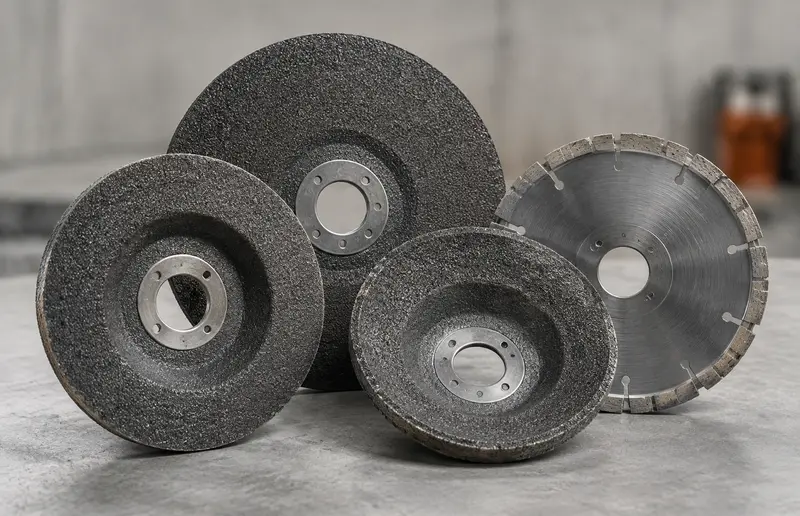
The correct angle-grinder disc for stainless steel is chosen from the operation first. Cutting, heavy grinding, weld blending and surface finishing create different loads and require different disc constructions. A disc marked “INOX” is not automatically suitable for every stainless-steel task or every grinder.
Quick answer: use a thin bonded cut-off wheel explicitly marked for stainless steel to cut sheet, tube or bar; a stainless-rated bonded grinding wheel for heavy stock removal and beveling; a flap disc for controlled weld blending, deburring and surface preparation; and a compatible non-woven surface-conditioning disc for lighter cleaning or finishing. Always match diameter, mounting, guard, maximum operating speed and permitted application to the exact angle grinder.
Which angle-grinder disc should you use for stainless steel?
| Operation | Suitable disc category | Main benefit | Critical limitation |
|---|---|---|---|
| Cut sheet, tube or small section | Thin reinforced cut-off wheel marked for stainless/INOX | Narrow kerf and efficient edge cutting | Do not side-grind or twist unless the exact wheel is dual-purpose |
| Heavy weld removal or bevel preparation | Bonded grinding wheel marked for stainless steel | Rigid construction for stock removal | Use only at the angle and on the faces permitted by the wheel maker |
| Blend a weld or deburr an edge | Stainless-rated flap disc | Combines removal with a more controlled finish | Grit, backing type and permitted contact angle must match the task |
| Remove light discoloration or prepare a finish | Approved non-woven surface-conditioning disc | More conformable, lower-gouging action | Not a substitute for a cut-off or heavy grinding wheel |
| Cut and grind with one accessory | Only a wheel explicitly labelled for both cutting and grinding | Designed and reinforced for both load directions | A standard thin cut-off wheel is not dual-purpose |
The table identifies categories, not universal products. Wheel-type codes, mounting systems and guard requirements differ by market and manufacturer. Read the label, packaging and tool manual together.
For the basic dimensions to verify on a common category, see the neutral 125 mm stainless-steel cut-off wheel profile.
Why stainless steel changes disc selection
Stainless steel can work-harden and retains heat near the contact zone. Excessive pressure, a glazed or unsuitable abrasive and repeated dwelling can discolor the surface, slow the cut and shorten disc life. The aim is not simply to use the hardest disc: it is to use a product formulated and labelled for the grade, operation and machine.
Surface contamination also matters. Carbon-steel particles embedded in stainless can later form rust marks. Use abrasives dedicated to stainless work and keep them separate from discs, wire brushes and files previously used on ordinary steel. Manufacturer stainless or INOX products may be formulated with restricted iron, sulfur and chlorine; confirm the actual product statement rather than assuming every disc with a similar color has the same composition.
Identify the workpiece before starting. Austenitic, ferritic, duplex and other stainless grades do not behave identically. Coatings, scale, weld filler and required finish also change the process. If the part has a specified surface finish, corrosion requirement or food/pharmaceutical service, follow the fabrication procedure for that application.
Cut-off wheels: cutting with the edge
A reinforced cut-off wheel is made to enter the work with its outer edge. Thin wheels reduce kerf and cutting effort, but their narrow section is vulnerable to side loading. Keep the cut aligned, support the work so the kerf cannot close on the disc and do not twist the grinder to correct a drifting cut.
3M states directly that standard cut-off wheels must not be used for grinding and that their maximum operating speed must be at least the maximum speed of the power tool. The exception is a product explicitly designed, reinforced and labelled as a combined cut-and-grind wheel. Never infer dual use from thickness alone.
Choose diameter and thickness from the grinder manual, access, material section and wheel manufacturer’s application table. A larger disc is not an upgrade for a smaller grinder. Removing the guard or fitting an oversized wheel exposes a larger peripheral section and can overspeed the accessory.
Bonded grinding wheels: heavy removal and beveling
A bonded grinding wheel is thicker and designed to remove material with an approved face and contact angle. It is used for weld removal, bevel preparation and heavier fabrication. A product marked for stainless steel helps maintain cutting performance and avoid unwanted ferrous contamination.
Grinding wheels are not all equivalent. Depressed-center, flat, cup and combination forms require compatible guards and flanges. Follow the wheel drawing and machine manual. Do not use the side of a wheel unless the manufacturer explicitly permits side grinding for that construction.
Pressure should keep the abrasive cutting without overloading the machine or glazing the wheel. If removal slows, do not compensate automatically by leaning harder. Stop and inspect the wheel, workpiece, contact angle, direction, grinder speed and suitability. Heat tint or a rapidly darkening surface is a process signal, not merely a cosmetic issue.
Flap discs and surface-conditioning products
Flap discs
A flap disc uses overlapping coated-abrasive flaps on a backing plate. It is useful for weld blending, deburring, edge chamfering and surface preparation. A coarse grit removes more aggressively; a finer grit refines the surface, but the final scratch pattern depends on mineral, backing, pressure, angle and prior steps—not grit number alone.
Flat Type 27 and conical Type 29 are common designations in North American product ranges. Norton describes flat flap discs for flatter contact and smoother blending, while conical designs provide greater contact for stock removal. Type names do not replace the actual product instructions, and European markings may use different classifications.
Zirconia and ceramic alumina products are common for stainless fabrication. A grinding aid may reduce heat and improve cutting, but mineral name alone does not guarantee compatibility. Select a disc whose label lists stainless steel and the intended operation.
Non-woven surface-conditioning discs
Non-woven abrasives can clean, blend and refine without the rigid action of a bonded wheel. They are useful after the geometry is already correct. They cannot safely replace a cut-off wheel, and their open structure does not remove the need to match speed, backing pad, mounting and guard requirements.
Diameter, bore, guard, flange and maximum speed
Compatibility is a chain. Every item below must agree:
- Machine type: the accessory must be approved for a right-angle grinder and the intended feed method.
- Diameter: never exceed the grinder and guard rating.
- Bore or thread: the mounting must fit the spindle and flange system without forced modification.
- Wheel type: flat, depressed-center, flap, fiber or combination designs may need different flanges, backing pads and guards.
- Maximum operating speed: the disc rating must be equal to or greater than the grinder’s maximum no-load speed.
- Guard: use the correct guard for the wheel type and position it between the operator and the wheel.
- Flanges and nut: use only the components and orientation specified for that wheel and grinder.
Variable-speed grinders do not make an oversized or underrated disc acceptable. A speed control can be moved accidentally, electronics can fail and the machine remains designed around particular accessories. The marked compatibility rules still apply.
Use the grinding-disc compatibility and peripheral-speed calculators to check arithmetic. A calculator does not inspect the wheel, validate a flange or authorize an application.
How to read the disc markings
Before mounting, locate the manufacturer, part number, diameter, thickness, bore or thread, maximum RPM or surface speed, material, application, wheel type, safety pictograms and any use-by information. If a marking is missing, illegible or inconsistent with the packaging, do not guess.
Symbols may indicate eye, face, hearing or respiratory protection; guard use; prohibited side grinding; and restrictions on damaged or wet wheels. The meaning of the symbol and the written instructions must be read together. A stainless/INOX label addresses material use; it does not override a “cutting only” restriction.
Inspect the accessory in good light. Reject cracked, chipped, warped, contaminated, water-damaged, dropped or otherwise questionable wheels. Resin-bonded wheels can be affected by age and storage, so follow the manufacturer’s date and storage rules. Do not apply one inspection test—such as a ring test—to every wheel construction; use the method specified for that exact product.
A conservative working method
- Define the operation: cutting, heavy grinding, blending, deburring or finishing.
- Identify the material and finish requirement: stainless grade, thickness, weld, contamination controls and final surface.
- Read both manuals: verify the grinder and exact disc are approved for each other and for the task.
- Isolate power: unplug the tool or remove the battery before changing the accessory.
- Inspect and mount: check markings and condition; fit the correct guard, flange, nut or backing pad without forcing the bore.
- Secure the work area: clamp the part, plan the spark path, remove exposed combustibles and keep people outside the hazard zone.
- Use a stable grip: install the side handle where required and position the guard between you and the wheel.
- Follow the start-up procedure: keep clear of the wheel plane and follow the manufacturer’s no-load check before contact.
- Use the permitted contact: edge cutting for cut-off wheels; approved face and angle for grinding or flap discs.
- Stop on change: unusual vibration, sound, smell, loss of speed, wheel damage or work movement ends the operation.
Let the wheel stop completely before setting the grinder down. Never use the workpiece to brake the disc. Disconnect power before clearing debris, changing the guard or inspecting the mounting.
The MatchMyTools selector can narrow the disc family by grinder size, stainless steel and operation. The final authority remains the exact disc label and grinder manual.
Troubleshooting stainless-steel grinding
| Observed problem | Areas to inspect | Safe response |
|---|---|---|
| Cut-off wheel binds or wanders | Work support, closing kerf, alignment, side load or worn wheel | Stop; support the work and restart with an aligned, suitable wheel |
| Heavy vibration | Damage, incorrect flange, debris, forced bore, loose mounting or grinder condition | Stop immediately, isolate power and inspect the complete assembly |
| Slow removal with high heat | Wrong disc, glazing, excessive pressure, poor angle or unsuitable grade | Stop and verify application and product data rather than applying more force |
| Rust marks after fabrication | Carbon-steel contamination from shared abrasives, tools or benches | Segregate stainless tooling and follow the project’s cleaning/passivation procedure |
| Uneven flap-disc finish | Inconsistent angle or pressure, skipped grit, worn flaps or wrong backing form | Use a controlled pattern and manufacturer-approved grit progression |
| Disc or backing overheats | Excessive pressure, dwell, wrong speed, loaded abrasive or unsuitable product | Stop, allow safe cooling and inspect before resuming |
Safety
Portable abrasive wheels can fail violently. Keep the manufacturer-specified guard installed, use suitable eye and face protection, hearing protection and task-specific protective equipment, and control grinding dust or other process-generated airborne contaminants according to the workpiece safety information and workplace assessment. Avoid loose clothing and keep the power cable outside the wheel and spark path.
OSHA requires the guard on a right-angle portable grinder to be positioned between the operator and the wheel so fragments are deflected away. OSHA also requires abrasive-wheel speed compatibility. Local rules may be stricter; the grinder manual, disc instructions and applicable regulations all remain binding.
Frequently asked questions
What disc should I use to cut stainless steel?
Use a reinforced cut-off wheel explicitly marked for stainless steel or INOX whose diameter, bore, wheel type and maximum speed match the grinder and guard. Cut with the edge and avoid side loading.
Can I grind with a thin cut-off wheel?
No, not with a standard cut-off wheel. Use it only for edge cutting. Grinding is permitted only when the exact manufacturer explicitly labels the wheel as a combined cut-and-grind product and specifies the required guard and contact method.
Which flap-disc grit is best for stainless steel?
There is no universal best grit. Coarse grit removes material faster; finer grit refines the scratch pattern. Start from the disc manufacturer’s application guide and the required final finish, then test a representative area.
Can I use a steel grinding disc on stainless steel?
Only if the exact disc is also marked for the stainless grade and operation. A general steel disc may cut poorly or introduce ferrous contamination. Keep stainless abrasives dedicated and separate.
Does a variable-speed grinder allow any disc size?
No. Speed control does not change the approved diameter, guard, flange, wheel type or mounting system. The disc rating must still be compatible with the grinder’s specified maximum no-load speed and intended accessories.
Technical references
- OSHA 1910.243 — Guarding of portable powered tools: guard position and exposure for right-angle grinders.
- OSHA — Abrasive wheel grinder checklist: inspection, guarding and speed compatibility.
- 3M — Cubitron II Cut-Off Wheels: cutting-only restriction, guards and maximum operating speed.
- 3M — Cut & Grind Wheel: a manufacturer example explicitly designed for both operations.
- Bosch Professional — Stainless-steel bonded cutting disc: material marking, iron-free formulation and dimensional options.
- Norton Abrasives — Flat stainless-steel flap disc: blending, deburring, stock removal and Type 27 use.
Important: this guide explains categories and compatibility checks. It does not authorize a wheel, speed, guard or technique. Follow the exact disc label, grinder manual, workplace assessment and applicable safety requirements.
The stated parameters are starting points. Test progressively on scrap and always respect manufacturer limits.