
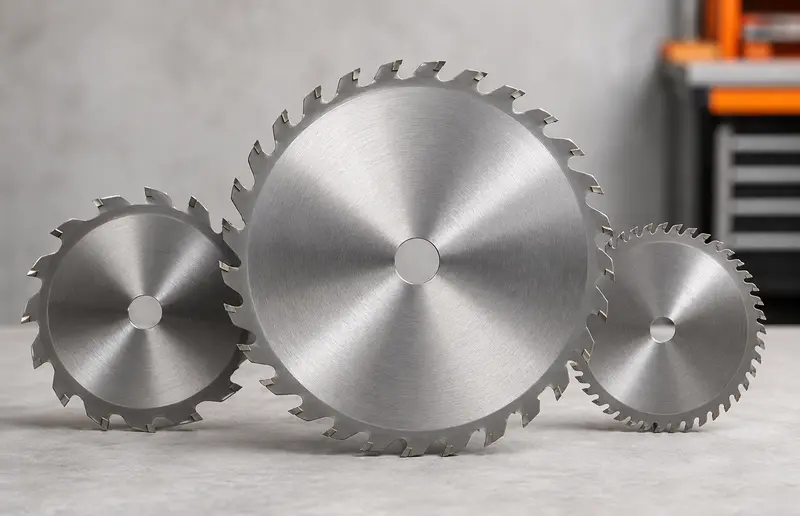
Circular-saw blade tooth count is not a stand-alone specification. The correct choice depends on blade diameter, material, stock thickness, grain direction, machine type and the finish required. A 24-tooth blade on a small hand-held saw does not have the same tooth spacing or application as a 24-tooth blade on a large stationary saw.
Quick answer: choose a lower tooth count within the manufacturer’s range for faster ripping and efficient chip clearance; move toward a higher count for smoother crosscuts and sheet-goods finishing. Then verify tooth geometry, hook angle, diameter, arbor, kerf, maximum RPM and machine approval. Tooth count alone never makes a blade compatible.
How many teeth should a circular-saw blade have?
| Cutting objective | Tooth-count direction | Geometry commonly specified | What to verify |
|---|---|---|---|
| Fast rip in solid wood | Lower count for the selected diameter | Rip or general-purpose pattern; often FTG or an aggressive ATB design | Grain direction, stock thickness, chip space, feed and saw power |
| General site work | Low to medium count | Manufacturer-labelled framing or combination blade | Nails and foreign objects, cut quality required and machine approval |
| Clean crosscut in solid wood | Medium to higher count | ATB or high-ATB product intended for crosscutting | Diameter, stock thickness, hook angle and feed |
| Plywood or veneered panel | Higher than a rough ripping blade | Fine-finish ATB or panel blade | Veneer face, backing support, tooth entry and product instructions |
| Melamine or laminate | Usually high, but not by count alone | Dedicated laminate/melamine geometry; scoring may be required on industrial machines | Machine type, coating on one or two faces, chipping requirement and blade label |
| Aluminium or other non-ferrous metal | Use the exact manufacturer selection table | Dedicated non-ferrous blade, commonly TCG with a controlled hook angle | Saw approval, workholding, section shape, wall thickness, RPM and lubricant instructions |
This table gives a direction, not a universal number. Catalogues contain 24-tooth, 40-tooth, 48-tooth, 60-tooth and higher-count blades, but those numbers only become meaningful with the diameter and application. Bosch, for example, describes higher-count ATB variants for clean results and lower-count variants for more solid cutting, while its actual options vary by diameter and machine category.
Use the neutral 24-tooth wood-blade profile and 60-tooth panel-blade profile as comparison records, not automatic recommendations.
Why blade diameter changes the tooth-count answer
Tooth count describes how many teeth are distributed around the circumference. If two blades have the same tooth count but different diameters, the larger blade has wider tooth spacing. That changes chip space, tooth engagement and the rate at which teeth pass the work at a given RPM. Comparing numbers without diameter can therefore be misleading.
Stock thickness also changes engagement. A blade that works cleanly in thin sheet may carry too many teeth through a thick rip, restricting chip clearance and increasing heat. Conversely, a very open ripping pattern may leave a coarse edge on thin veneered plywood. Use the manufacturer’s chart for the exact blade series, diameter, stock range and cut direction.
Blade projection matters on machines that permit depth adjustment. The saw manual defines the safe setup; exposing more blade than needed does not convert a finishing blade into a ripping blade. It can change tooth engagement and increase the exposed hazard. Follow the machine instructions rather than applying one projection rule to every saw.
Rip cuts, crosscuts and combination blades
Ripping with the grain
Ripping produces long chips and can keep several teeth in dense material. Lower-count ripping blades provide larger gullets for chip removal and generally require less feed force than a fine crosscut blade. Freud identifies low tooth count as suitable for thick-stock ripping, but the exact count and thickness range are product-specific.
A blade that is too fine for a deep rip may cut slowly, accumulate pitch, heat the plate and increase feed pressure. Do not solve this by forcing the work or disabling a guard. Stop, disconnect power and check sharpness, cleanliness, blade type, alignment and the published material range.
Crosscutting across the grain
Crosscutting severs fibres across their width. More, smaller bites and an appropriate bevel geometry can reduce breakout and leave a smoother edge. Higher count is not limitless: too many teeth for the section, feed and machine can rub rather than cut efficiently.
Combination and general-purpose blades
A combination blade is a compromise for users who alternate between ripping and crosscutting without changing blades. It can be appropriate for routine work, but it will not necessarily equal a dedicated rip blade in thick stock or a dedicated fine-finish blade on visible veneer. The manufacturer must list both operations for the product.
Choosing by material
Solid wood
First identify rip or crosscut, then consider species, moisture, knots, thickness and final edge requirement. Dense hardwood and thick stock can overload a blade chosen only for finish. Resin or pitch deposits also change cutting behaviour; clean and service the blade using the maker’s procedure.
Plywood and veneered panels
A higher-count fine-finish blade is commonly selected to reduce face-veneer breakout. Support the panel close to the cut so the kerf cannot close and pinch the blade. On the DEWALT DCS571 hand-held circular saw, the manual says to place the good face down because the blade cuts upward and splintering occurs on the upper face. That instruction is machine-specific: table saws and other configurations have a different tooth-entry side, so verify the manual and test a scrap.
MDF and particleboard
These homogeneous panels do not have long grain, but their resin and abrasive fibres can dull teeth. Select a blade explicitly rated for the panel and required finish. Extraction, blade sharpness and steady support are as important as tooth count. Control dust according to the material safety information and workplace assessment.
Melamine and laminate
Brittle surface layers can chip before the substrate is fully cut. A dedicated high-count blade and suitable tooth geometry may help; industrial panel saws may also use scoring systems. A high number printed on a generic wood blade does not guarantee a chip-free result on both faces.
Plastics
Acrylic, polycarbonate, PVC and solid-surface materials have different heat and fracture behaviour. Use a blade whose product data names the plastic and thickness range. Avoid copying a wood-blade count without checking geometry, rake, chip clearance and heat control.
Aluminium and non-ferrous metals
Use only a blade and saw explicitly approved for the alloy, profile and operation. Dedicated products may use a high count, TCG geometry and a neutral or negative hook angle, but these details are not universal. Clamp the work as directed and follow the manufacturer’s lubrication and chip-control instructions. The neutral non-ferrous saw-blade profile lists the compatibility fields to confirm.
Tooth geometry matters as much as count
- FTG — flat top grind: a square cutting edge with generous chip space, commonly used in ripping products.
- ATB — alternate top bevel: alternating bevels slice wood fibres and are common on crosscut and general wood blades.
- High ATB: a steeper bevel can refine veneer cutting but may be more application-specific and sensitive to wear.
- TCG — triple chip grind: alternating chamfered and flat teeth are used on some laminate, plastic and non-ferrous products.
- Combination patterns: groups of different teeth and gullets balance several operations.
These names describe patterns, not permission. Carbide grade, plate thickness, tensioning, kerf, expansion slots and tooth angles also affect the result. Select from the blade maker’s application data rather than assuming every ATB or TCG blade is interchangeable.
Hook angle influences how aggressively a tooth enters the work. A positive hook can feed more assertively; controlled or negative angles appear on some sliding mitre and non-ferrous blades. The machine mechanism and feed direction matter, so never transfer a hook-angle recommendation from one saw type to another without approval.
Match the blade to the saw type
| Machine | How the work is fed | Selection emphasis | Common mistake |
|---|---|---|---|
| Hand-held circular saw | The saw moves through supported work | Exact diameter/arbor, lower-guard function, cutting direction, manageable feed and application label | Fitting an oversized blade or holding the lower guard open |
| Table saw | The work moves past a fixed blade | Blade/kerf compatibility with guard and riving knife, fence alignment and rip/crosscut objective | Using a thin kerf incompatible with the riving knife or feeding against instructions |
| Mitre or sliding mitre saw | The head pivots or slides through clamped/supported work | Blade specifically approved for mitre/slide use, hook angle, crosscut quality and workholding | Using an aggressive ripping blade not approved for the mechanism |
| Track/plunge saw | The saw runs on a guide rail and plunges into the cut | Exact system compatibility, kerf relative to splinter strip and blade for sheet goods | Assuming any blade of the same nominal diameter matches the rail system |
Compatibility checks before mounting
Every point below must agree with the saw and blade documentation:
- Diameter: use only the size range and guard configuration approved by the saw maker.
- Arbor or bore: the hole shape and diameter must seat correctly on the spindle and flanges; never force or improvise the mounting.
- Maximum speed: the blade rating must meet or exceed the saw’s maximum no-load RPM.
- Kerf and plate thickness: these must be compatible with the riving knife, guard, brake or sensing system where fitted.
- Rotation: align the blade arrow with the machine’s specified direction.
- Application: confirm material, cut direction, stock range and machine type on the exact part number.
- Condition: reject cracked, warped, missing-tooth, loose-tip or otherwise damaged blades.
The DEWALT DCS571 manual explicitly requires correct diameter and centre-hole shape, proper rotation, and a blade maximum RPM at least equal to the saw speed. Use the saw-blade compatibility and peripheral-speed calculators to check arithmetic, but not to authorize a blade or mounting.
A conservative selection and test method
- Identify the machine: record model, approved blade diameter, arbor, no-load RPM, guard and riving-knife limits.
- Define the cut: rip, crosscut, sheet sizing, finish cut or approved non-ferrous operation.
- Identify the stock: material, thickness, coating, grain direction, hidden fasteners and visible face.
- Choose a manufacturer category: rip, combination, crosscut, panel, laminate or non-ferrous.
- Compare complete specifications: tooth count, geometry, hook angle, kerf, plate, diameter, arbor and RPM.
- Isolate power: unplug the saw or remove the battery before touching the blade or guard.
- Inspect and mount: clean seating surfaces, check blade condition and follow the exact flange and fastener orientation.
- Support the work: clamp or guide it as required and arrange offcuts so the kerf cannot close.
- Test a representative scrap: use the intended face orientation, feed direction and support.
- Stop on warning signs: binding, kickback tendency, burning, heavy vibration, unusual noise or damaged teeth requires inspection.
The MatchMyTools selector can narrow the blade family by saw, material and operation. The exact blade label and saw manual remain the final authority.
Troubleshooting circular-saw cut quality
| Observed problem | Areas to inspect | Safe response |
|---|---|---|
| Rough crosscut or veneer breakout | Blade category, tooth count/geometry, sharpness, face orientation, support and feed | Use a manufacturer-rated fine-finish blade and test the tooth-entry face on scrap |
| Burning or excessive feed force | Dull or dirty blade, too many teeth for the rip, misalignment, pinched kerf or forced feed | Stop, isolate power and correct the cause; do not push harder |
| Blade binds in a panel | Support placement, closing kerf, warped stock, guide alignment and blade condition | Release the trigger, hold the saw still until stopped and re-support the work |
| Wandering cut | Guide, base/fence alignment, blade stiffness, damaged teeth, feed and work movement | Stop and inspect the complete setup before restarting |
| Heavy vibration or noise | Mounting, arbor fit, debris on flanges, warped plate, missing carbide or saw bearings | Stop immediately and remove the tool from service until corrected |
| Melamine chips on both faces | Wrong blade, worn teeth, unsupported panel, machine configuration or missing scoring process | Use the dedicated product/process specified for the required finish |
Safety
Circular saws can cause severe laceration, kickback and projectile hazards. Keep all manufacturer guards and control systems operational, use suitable eye and hearing protection, control dust, keep hands out of the cutting path and wait for the blade to stop before setting down or adjusting the saw. Inspect stock for fasteners and other foreign objects unless the exact blade is explicitly designed and approved for them.
OSHA requires upper and lower guards on portable power-driven circular saws over 2 inches, with the lower guard automatically returning to cover the blade when the tool leaves the work. Machine manuals add model-specific rules. The Makita 5007MGA manual also emphasizes supporting large panels close to the cut to reduce blade pinching and kickback.
Frequently asked questions
How many teeth should a 7-1/4-inch circular-saw blade have?
There is no single correct number. Lower-count blades in that diameter are generally intended for faster ripping or framing, while higher-count variants target cleaner crosscuts and sheet goods. Choose from the saw and blade manufacturers’ application tables, then verify arbor, kerf, RPM and material.
Is a 24-tooth or 60-tooth blade better?
Neither is universally better. A 24-tooth blade commonly clears chips faster in rough or rip work; a compatible 60-tooth blade commonly gives a finer crosscut or panel finish. Diameter, tooth geometry, stock thickness, saw type and product rating decide whether either blade is suitable.
Can I use the same blade on a table saw and a mitre saw?
Only when the exact blade manufacturer approves both machines and all specifications match. Diameter and arbor alone are insufficient: hook angle, kerf, plate thickness, maximum RPM, guard, riving knife and sliding action can change compatibility.
Which side of plywood should face up with a circular saw?
On the DEWALT DCS571 hand-held saw, the manufacturer says to place the good face down because its blade cuts upward and splintering appears on top. Other saw configurations differ, so identify the tooth-entry side in the manual and confirm with a supported scrap cut.
Can a normal wood blade cut aluminium?
Do not assume it can. Use only a saw and blade explicitly approved for the alloy, profile, thickness and operation. A dedicated non-ferrous blade may require different tooth geometry, hook angle, workholding, chip control and lubrication from a wood-cutting blade.
Technical references
- OSHA 1910.243 — Guarding of portable powered tools: upper and self-closing lower guards for portable circular saws.
- DEWALT DCS571 instruction manual: blade diameter, arbor, RPM, rotation, work support and visible-face orientation.
- Makita 5007MGA instruction manual: panel support and kickback controls.
- Bosch Professional — Expert for Wood blades for hand-held saws: ATB geometry and tooth-count direction for clean or solid cutting.
- Freud — Thick-stock ripping blade: low tooth count for ripping thick hardwood and softwood.
- Freud — Aluminium and plastics blade: a dedicated TCG, high-count, negative-hook product example.
Important: this guide explains selection logic; it does not approve a blade, machine, feed or material. Follow the exact blade data, saw manual, workplace assessment and applicable safety rules.
The stated parameters are starting points. Test progressively on scrap and always respect manufacturer limits.