
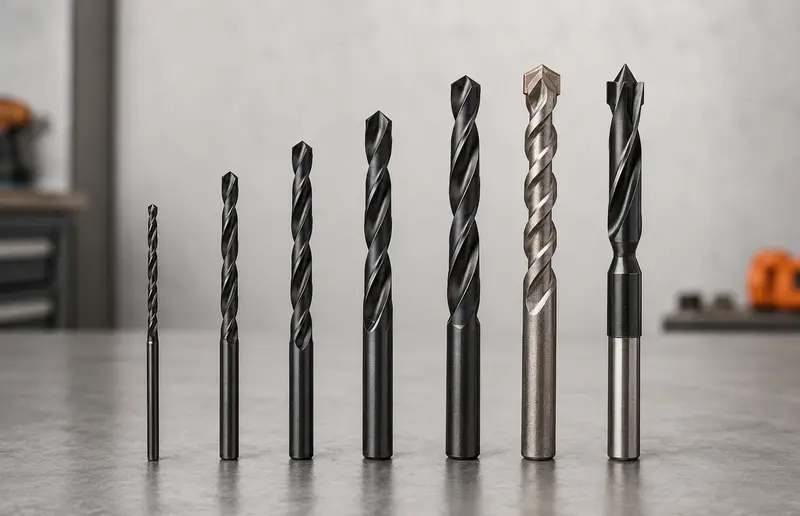
Choosing a drill bit by material starts with the workpiece, but it does not end there. Wood, steel, stainless steel, aluminium, sheet metal, plastic, tile, brick and concrete need different cutting edges, flute designs, tool materials and machine modes. The hole diameter, depth, accuracy and drill or rotary-hammer interface must also match.
Quick answer: use a brad-point or another manufacturer-rated wood bit for clean positioning in timber and panels; an application-rated HSS, cobalt-alloy HSS or carbide drill for metal; a step drill for compatible thin sheet; a dedicated plastic or suitable sharp twist drill where approved; a tile bit in the specified rotary mode; and a carbide-tipped masonry or SDS bit with the exact hammer drill or rotary hammer it was designed for. Never select from material name alone—verify shank, chuck, mode, diameter, usable length, speed and hidden-service risks.
Which drill bit should you use for each material?
| Workpiece | Common starting category | Machine mode | Critical limitation |
|---|---|---|---|
| Solid wood | Brad-point for accurate holes; auger, spade, Forstner or hole saw for manufacturer-approved larger holes | Rotary drilling | Bit type, diameter, depth and exit support must suit the hole |
| Plywood, MDF or particleboard | Sharp brad-point or panel-rated bit; backing board where appropriate | Rotary drilling with dust control | Face breakout, abrasive fibres, glue layers and dust are not solved by point shape alone |
| Mild or alloy steel | Sharp metal-rated twist drill, commonly HSS-G or another specified grade | Rotary drilling | Use the exact cutting data, coolant/lubricant and workholding for the steel and diameter |
| Stainless steel | Product explicitly rated for the stainless grade; cobalt-alloy HSS or carbide may be specified | Stable rotary drilling | Rubbing, poor chip evacuation and an unstable process can increase heat and work hardening |
| Aluminium | Sharp twist drill rated for the alloy; suitable geometry/coating and lubricant as specified | Rotary drilling | Built-up material and long chips require attention to evacuation |
| Thin sheet metal | Split-point twist drill or step/cone drill within its published thickness range | Rotary drilling with firm clamping | Breakthrough can grab or spin an unsecured sheet |
| Acrylic or plastic | Dedicated plastic drill or sharp twist drill explicitly approved for that polymer | Controlled rotary drilling | Heat, cracking and grabbing vary by polymer, thickness and point geometry |
| Brick or masonry block | Carbide-tipped masonry or multi-construction bit rated for the substrate | Rotary or impact mode exactly as the product specifies | Hollow units, fragile faces and hidden services require a planned depth and mode |
| Concrete | Compatible carbide-tipped percussion bit or SDS-plus/SDS-max hammer bit | Hammer drill or rotary hammer specified for the shank and diameter | Rebar, silica dust, embedments and anchoring requirements need separate controls |
| Ceramic or glass tile | Dedicated tile/glass bit for the exact hardness | Usually rotary, non-hammer mode unless the bit maker explicitly says otherwise | The tile and the wall behind it may require two different bits and modes |
The categories above are starting points, not universal approvals. Bosch’s own catalogue separates brad-point wood bits, HSS-G metal bits, step drills, hard-ceramic bits, multi-construction bits and SDS hammer bits. That separation shows why one “multipurpose” label should not override the exact material and mode list on the product.
Compare the neutral brad-point wood-bit, HSS twist-drill and sheet-metal step-drill profiles to see which compatibility fields change.
Drill bits for wood, plywood and MDF
Brad-point bits for positioning and clean entry
A brad-point tip uses a centre point to establish the hole before the outer cutting edges remove the circumference. Bosch describes this geometry as helping to start clean, accurate holes in wood. It is useful for dowel work, furniture parts and repeatable drill-press operations when the bit diameter and working length are suitable.
The centre point does not prevent all breakout. Near the exit face, unsupported fibres can tear. Use a backing board where the operation permits, clamp both layers and reduce feed as the point approaches breakthrough. On veneered plywood, confirm which face is critical and test the complete stack on scrap.
Twist, auger, spade and Forstner-style bits
A sharp twist drill can make small utility holes in wood when the manufacturer lists that use. Auger and spade bits target deeper or larger holes with different chip-clearance and torque requirements. Forstner-style bits are used for flat-bottomed or overlapping holes on suitably rigid setups. Hole saws remove a ring rather than the full diameter. These categories are not interchangeable simply because their nominal diameter is equal.
Larger wood bits can produce a strong reaction torque, especially if the cutting edge catches or the chip path becomes packed. Check whether the hand drill requires an auxiliary handle, use the speed range in the manual and secure the work. A drill press adds alignment and support but does not authorize an oversized bit beyond chuck, spindle or table capacity.
Plywood, MDF and particleboard
Panel products combine fibres, veneers, resins and sometimes hard surface layers. A sharp bit, stable backing and good extraction usually matter more than a marketing label alone. MDF dust is fine and the resin content can accelerate wear. Stop if the bit is burning, pushing fibres rather than cutting, or leaving unusually hot dust.
Drilling steel, stainless steel and aluminium
Mild and alloy steels
Ground HSS twist drills are common for general metalwork. Bosch’s PRO Metal HSS-G range, for example, names alloyed and unalloyed steel, non-ferrous metals, cast iron and selected plastics and wood. That is a statement about that product range—not proof that every HSS drill fits every grade.
For an accurate start, a split point can reduce walking, but marking and centre-punching may still be required by the procedure. Clamp the work, keep the bit aligned and use cutting data for the exact diameter, tool grade, coating, hole depth and material. A drilling formula calculates RPM only after a valid cutting speed has been obtained from the manufacturer.
Stainless steel
Stainless grades differ widely. Some work-harden when the edge rubs instead of forming a chip. A dull drill, excessive speed, weak feed, poor rigidity or repeated dwelling can create heat and a hardened surface that makes restarting difficult. Use a sharp product explicitly rated for the grade and keep the process stable within its published data.
Cobalt-alloy HSS drills are frequently selected for heat resistance and tougher metals; solid carbide or carbide drills may offer wear resistance in a rigid machine. Neither label is an automatic upgrade. Dormer Pramet notes that HSS is tougher and works at lower cutting speeds, while carbide is harder and more wear-resistant but more brittle and dependent on a stable process.
Aluminium and non-ferrous metals
Aluminium can form long chips or adhere near the cutting edge. Select a drill whose geometry and surface treatment are listed for the actual alloy and hole. Follow the maker’s guidance for lubrication or coolant; some coatings and applications are intended to run differently. Retract or clear chips only as instructed and after controlling the rotating tool and swarf hazard.
Thin sheet, acrylic and other plastics
Step drills for compatible sheet
A step drill enlarges the hole through a sequence of diameters and is useful in thin-walled material within the product’s range. Bosch describes its HSS step drill as providing several diameters, a split-point start and spiral-flute chip removal. Stop at the required marked step; forcing the next step can oversize the hole.
Sheet metal must be firmly clamped. As a conventional twist drill breaks through, its lips can grab; the work can spin or distort if held by hand. Deburr with a tool intended for that operation. A step drill is not a substitute for a twist drill in deep solid stock.
Acrylic, polycarbonate and other plastics
“Plastic” covers materials with very different melting, cracking and grabbing behaviour. A dedicated plastic drill may use a point and rake intended to reduce pull-in. Some sharp HSS-G twist drills are explicitly listed for plastics, but that does not authorize every HSS geometry.
Support the exit face, clamp without distorting the sheet and test a scrap from the same material. Stop if chips melt onto the drill, the hole develops radial cracks or the bit pulls itself through. Review point geometry, sharpness, speed, feed, backing and cooling instructions rather than increasing pressure.
Brick, concrete, stone and tile
Masonry bits and cylindrical-shank impact drilling
Carbide-tipped masonry bits are designed to crush and remove mineral material. The exact product decides whether it uses rotary-only or impact mode. Bosch’s CYL-9 MultiConstruction bit, for example, permits impact mode on concrete and stone but rotary mode for brick, soft tile, sheet metal, wood and plastic. Do not generalize one mode across other bits.
SDS-plus and SDS-max hammer drilling
SDS hammer bits are made for compatible rotary hammers. Bosch lists its SDS plus-1 concrete bit for SDS-plus rotary hammers and a carbide cutting plate with flutes for dust removal. SDS-plus and SDS-max differ in interface and capacity; neither should be forced into a three-jaw chuck or the wrong SDS holder.
Choose total length and usable length separately. A bit can fit the holder yet be too short for the required embedment or too long for stable control. For anchors, hole diameter, depth, cleaning method and edge distance come from the anchor system—not from the drill-bit guide.
Reinforced concrete and hidden services
Do not treat resistance inside a wall as permission to push harder. It may be aggregate, reinforcement, conduit, electrical wiring, water or gas service. Review drawings, survey the area with appropriate detection equipment and isolate relevant services before drilling. Structural reinforcement must not be cut without the project’s approved procedure. A special rebar cutter is a separate accessory, not a default response to an obstruction.
Ceramic, porcelain and glass tile
Tile hardness determines the accessory. Bosch specifies rotary-only, low-speed use for its CYL-9 soft-ceramic bit, while its hard-ceramic range uses a different carbide head. Start on the glazed face according to the product instructions. After the tile layer is penetrated, stop and select the correct bit and mode for the substrate behind it; do not automatically continue with hammer action through a fragile surface.
What HSS, cobalt and carbide actually mean
| Tool material or construction | Typical strength | Main limitation | Selection rule |
|---|---|---|---|
| HSS | Tough, broadly used for twist drills and lower cutting speeds | Wear and heat resistance depend on grade, geometry and application | Confirm the exact workpiece list and cutting data |
| Cobalt-alloy HSS | Improved hot hardness for some tougher-metal applications | More brittle than basic HSS and not automatically suitable for every stainless grade | Use only when the product names the material and process |
| Carbide-tipped | Hard cutting insert combined with a tougher body; common in masonry | The tip and braze can be damaged by wrong mode, impact or side load | Match substrate, percussion mode and holder |
| Solid carbide | High wear resistance and cutting capability in stable production drilling | Brittle and sensitive to runout, vibration and unstable hand feeding | Use the machine, holder and data required by the manufacturer |
| Coated drill | A coating may reduce wear, heat or adhesion in specified applications | Colour does not identify capability, and resharpening changes the coated edge | Read the coating and application statement for the exact part number |
Do not choose by colour. Black, gold, bronze or bright finishes may indicate different manufacturing or coating systems, but appearance is not a reliable material code. The part number and technical sheet are the evidence.
Chuck, hex shank, SDS-plus and SDS-max
- Cylindrical shank: held by a compatible three-jaw or precision chuck within its capacity.
- Three-flat shank: flats can improve torque transfer in a compatible chuck, but shank diameter still must fit.
- Quarter-inch hex: used by compatible holders and chucks; a hex shank does not prove that the cutting edge is impact-rated.
- SDS-plus: slotted interface for compatible SDS-plus rotary hammers and an appropriate diameter range.
- SDS-max: larger, different interface for compatible heavy rotary hammers; not interchangeable with SDS-plus.
Check chuck capacity against the shank, not the cutting diameter. A large step drill may have a smaller shank, but machine torque and accessory limits still apply. Inspect the shank and holder for wear, clean them as directed and seat the accessory fully. Never modify a shank to make it fit.
Speed, feed, cooling and chip evacuation
Drill RPM depends on cutting speed and diameter. As diameter increases, the RPM required for the same surface speed decreases. The drilling RPM and cutting-speed calculators can perform that arithmetic, but the cutting speed must come from a valid source for the exact tool, coating, workpiece and process.
Apply pressure in line with the bit. Too little feed can rub and heat a metal surface; too much can overload the drill, chip the cutting edge or cause a stall. DEWALT’s DCD794 manual warns that an overloaded drill may stall and twist suddenly. Expect reaction torque, use the required auxiliary handle and position yourself to maintain control.
Deep holes may require chip-clearing cycles, through-coolant or a specialized flute design. Do not improvise a pecking schedule for every material. Follow the bit maker’s depth-to-diameter limits and the machine procedure. Keep hands away from rotating swarf; stop and isolate power before clearing entangled chips.
A conservative drilling method
- Identify the substrate: include coating, hardness, reinforcement, voids and what is behind the visible surface.
- Define the hole: diameter, depth, tolerance, finish, through or blind, and whether it is for an approved anchor.
- Check hidden services: review plans, detect utilities and isolate electricity, water or gas where required.
- Select the bit category: choose a product that explicitly lists the material, thickness range, mode and machine.
- Match the interface: confirm chuck or SDS type, shank diameter, working length and clearance.
- Obtain cutting data: use manufacturer RPM, feed, percussion and coolant or dust-control instructions.
- Isolate before mounting: unplug the drill or remove the battery, then inspect and seat the bit correctly.
- Secure the work: clamp portable parts and support the exit face; never hold small or round work by hand.
- Start under control: align the drill, use handles as specified and begin without side loading.
- Stop on change: unexpected resistance, smoke, cracking, grabbing, stalled rotation, abnormal vibration or suspected service contact ends the operation.
The MatchMyTools selector can narrow drill-bit families by machine and material. The exact product instructions, machine manual and workplace procedure remain authoritative.
Troubleshooting and safety
| Observed problem | Areas to inspect | Safe response |
|---|---|---|
| Bit walks at the start | Point geometry, damaged tip, marking, surface coating, alignment or insufficient fixture | Stop and use the manufacturer-approved starting method; do not hold the work by hand |
| Metal drill squeals, smokes or stops cutting | Dull edge, excessive speed, weak feed, missing lubricant, poor alignment or hardened surface | Stop, allow safe cooling and correct the process before restarting with a suitable sharp tool |
| Wood exit face splinters | Backing support, bit sharpness, feed at breakthrough and product geometry | Clamp a backing board where permitted and test on representative scrap |
| Plastic melts or cracks | Wrong point/rake, dull edge, heat, unsupported exit or grabbing at breakthrough | Stop and verify a plastic-rated tool and complete parameter set |
| Masonry drilling slows suddenly | Aggregate, rebar, wrong mode, worn carbide, packed dust or hidden service | Stop; survey the obstruction and never force through an unknown object |
| Drill or workpiece twists | Bit jam, inadequate clamping, missing auxiliary handle, wrong gear or breakthrough grab | Release the trigger while maintaining control, isolate power and correct the setup |
Wear task-appropriate eye protection and control noise, chips and dust. Secure work with clamps or another stable method; DEWALT warns that holding a workpiece by hand or against the body is unstable. Keep loose clothing, hair and gloves that can entangle away from the rotating bit and chuck.
Concrete, brick and stone drilling can generate respirable crystalline silica. OSHA’s construction standard includes specified engineering controls for handheld and stand-mounted drills, such as shrouds or cowling with dust collection in covered tasks. Apply the rules and exposure assessment for the actual workplace; a household vacuum or disposable mask is not an automatic substitute.
Frequently asked questions
What is the best drill bit for wood?
There is no single best type. A brad-point bit is useful for clean, accurately positioned holes; auger, spade, Forstner-style and hole-saw products cover different diameters, depths and hole forms. Choose the exact product by hole geometry, machine capacity, chip clearance and finish.
Can an HSS drill bit drill stainless steel?
Only if the exact HSS product is rated for the stainless grade and operation. Cobalt-alloy HSS or carbide may be specified for tougher applications, but stability, sharpness, cutting data, feed, cooling and chip evacuation matter as much as the material label.
Should hammer mode be used when drilling tile?
Usually not for a standard tile-drilling stage. Bosch specifies rotary-only, low-speed use for its CYL-9 soft-ceramic bit. Follow the exact tile-bit instructions; after passing the tile, stop and select the correct bit and mode for the substrate behind it.
Can an SDS drill bit fit a normal three-jaw chuck?
Do not assume compatibility. SDS-plus and SDS-max are slotted interfaces designed for matching rotary-hammer holders. Use only a manufacturer-approved adapter and operating mode if the tool documentation explicitly permits one; never force an SDS shank into a conventional chuck.
Why does a metal drill bit become hot and stop cutting?
Common causes include a dull or unsuitable edge, excessive speed, insufficient cutting feed, poor alignment, inadequate lubrication or chip evacuation, and a work-hardened surface. Stop rather than adding force, then verify the tool, material and manufacturer cutting data.
Technical references
- Bosch Professional — Drill bits: separate product families for wood, metal, construction, tile and hammer drilling.
- Bosch Professional — PRO Wood HSS brad-point bits: centre-point function and wood application.
- Bosch Professional — PRO Metal HSS-G twist drill: named materials and split-point design.
- Bosch Professional — HSS step drill: stepped diameters, split point and chip evacuation.
- Bosch Professional — SDS plus-1 hammer bit: concrete application, carbide plate and SDS-plus holder.
- Bosch Professional — CYL-9 soft-ceramic bit: rotary-only, low-speed tile drilling.
- DEWALT DWE5010 instruction manual: workholding and bit categories for wood, metal and masonry.
- DEWALT DCD794/DCD799 instruction manual: sharp-bit guidance, overload stall and reaction torque.
- Makita XAD03 instruction manual: insulated gripping surfaces where a bit may contact hidden wiring.
- Dormer Pramet — Selecting cutting data: HSS toughness, carbide wear resistance and process stability.
- OSHA 1926.1153 — Respirable crystalline silica: exposure-control requirements for covered concrete-drilling tasks.
Important: this guide explains drill-bit categories and compatibility checks. It does not approve a bit, speed, feed, anchor or drilling location. Follow the exact bit data, machine manual, structural requirements, utility survey and applicable safety rules.
The stated parameters are starting points. Test progressively on scrap and always respect manufacturer limits.