
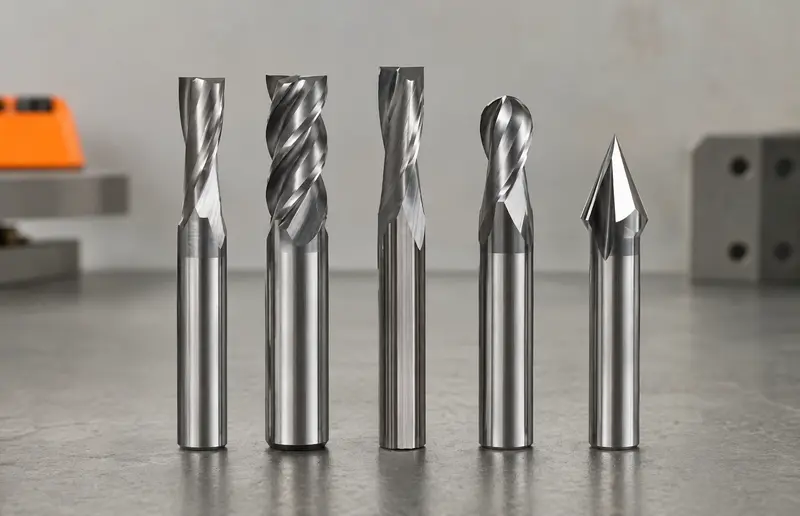
MDF is uniform, but it is not easy on cutting tools. Its fibres, binders and fillers produce fine abrasive dust, dull edges quickly and retain heat when the cutter rubs instead of making a defined chip. The best router bit for MDF therefore depends on the operation, edge finish, depth, extraction and machine—not on one universal diameter.
Quick answer: a sharp solid-carbide spiral bit is a strong general choice for MDF. Use an upcut for deep pockets and slots where evacuation is the priority, a downcut for shallow work where the top edge matters, and a compression bit mainly for through-cut laminated MDF when both faces must stay clean. For decorative profiles, use a carbide profile bit whose shank, diameter, cutting length and maximum RPM match the router.
Which router bit should you use for MDF?
| Operation | Useful starting choice | Main advantage | Main check |
|---|---|---|---|
| Deep pocket or closed slot | Solid-carbide upcut spiral | Moves dust and chips out of the cut | Top-edge finish and secure workholding |
| Shallow dado or top-surface pocket | Downcut spiral | Supports the top edge | Chip packing and temperature |
| Through-cut in raw MDF | Upcut or compression according to face priority | Balances evacuation and edge quality | Spiral direction at each visible face |
| Through-cut in laminated MDF | Compression spiral | Can protect both decorative faces | Transition fully positioned inside the panel |
| Template trimming | Carbide flush-trim or pattern bit | Follows a bearing or guide | Bearing position and cutting height |
| Roundover, chamfer or decorative edge | Carbide profile bit | Creates the required finished shape | Profile size, pass depth and rated RPM |
| Large flat surface or spoilboard | Approved surfacing cutter | Covers a wider path | Machine power, rigidity, tramming and maximum RPM |
The table provides categories, not a product prescription. Confirm the exact part number against the cutter and machine manufacturers before use.
Why MDF changes router-bit selection
MDF has no natural grain direction, so it routes consistently across the sheet. That uniformity is useful for profiles, doors, lettering and painted components. However, the material is dense and abrasive. A worn edge can leave a furry surface, rounded detail or dark burn marks long before the cutter looks visibly damaged.
Routing also produces a high volume of fine dust rather than the larger chips associated with many solid woods. That dust can recirculate in a closed groove, increase heat and obscure the cut. Effective extraction at the source is therefore part of the cutting setup, not merely a cleanup step.
Raw MDF edges are porous. Even a technically clean cut may need sanding and sealing before paint. Do not confuse normal edge porosity with tear-out; inspect whether the geometry is accurate and free of burning or deep tool marks.
Which router-bit type fits the operation?
Straight and spiral bits
These are used for dadoes, pockets, mortises and profiles. A spiral edge engages progressively and controls the direction of the removed material. Solid carbide is common for smaller spiral cutters and offers useful wear resistance in abrasive sheet goods, but it is brittle and requires low runout, sound collets and secure workholding.
Flush-trim and pattern bits
Choose the bearing position from the location of the template. The cutting height must cover the MDF without bringing the non-cutting shank or body into contact. Inspect the bearing before use; MDF dust can contaminate a bearing and a seized bearing can damage the template and workpiece.
Profile and cabinet-door bits
Roundovers, chamfers, ogees and MDF door profiles can remove substantial material. Use progressive passes unless the exact cutter documentation and machine capability support another strategy. Large profile cutters require special attention to maximum RPM, router-table guarding, fence setup and stock control.
Surfacing cutters
Surfacing bits are useful for CNC spoilboards and flat faces. Their large diameter increases cutter speed at the perimeter and magnifies spindle misalignment. Verify approved diameter, holder, maximum RPM, machine rigidity, shallow depth and overlap. Tram the spindle if repeated ridges appear.
Upcut, downcut or compression for MDF?
An upcut spiral is generally the practical option for deeper enclosed work because it pulls waste out of the slot. It may leave a less tidy top edge, particularly on coated or laminated material.
A downcut spiral presses toward the upper surface and can improve that edge. In a deep slot it can also force dust downward, where the cutter recuts it. Use a compatible pass depth and stop if heat or packed waste increases.
A compression bit combines upcut edges near the tip with downcut edges above them. It is most relevant to a through-cut in double-sided laminated MDF. The upcut section must remain below the top decorative layer during the finished cut; otherwise it can still chip that surface. For the complete geometry explanation, read Upcut vs Downcut vs Compression Router Bits.
Diameter, shank and cutting length
Diameter
A smaller diameter produces tighter internal radii and a narrower kerf, but it is less rigid. A larger diameter can be stiffer and productive on a capable machine, but requires wider radii, more power and a compatible speed range. Choose from geometry and machine capacity rather than MDF thickness alone.
Shank and collet
The shank must exactly match a clean, undamaged collet. Keep the flutes and transition radius outside the collet, insert enough straight shank for secure grip and avoid bottoming the bit inside the collet. Excessive runout accelerates wear and degrades the MDF edge.
Cutting length and stickout
Use the shortest cutter that covers the real engagement. Excessive projection reduces rigidity. Cutting length, overall length and flute transition are different dimensions; read the dimensioned drawing rather than estimating from a photograph.
A conservative MDF cutting method
- Define the operation and visible faces. A pocket, profile and through-cut do not need the same geometry.
- Choose a manufacturer-approved cutter. Confirm MDF or composite-wood compatibility, machine type, shank and rated maximum RPM.
- Inspect the setup. Clean the collet, minimize stickout, secure the panel and check tool sharpness and runout.
- Connect source extraction. Position the hood or shoe so dust is captured without interfering with the toolpath.
- Use manufacturer cutting data. Select the row for the exact tool series, diameter, flute count, material and depth.
- Test matching scrap. Use the same MDF grade, coating, thickness and support as the final part.
- Observe the cut. Defined waste, stable sound and a cool, accurate edge are more useful than copying a generic RPM value.
- Change one variable at a time. Record the result so the final setup is repeatable.
Deep engagement changes the recommended load. LMT Onsrud’s MDF cutting-data table, for example, reduces its series-specific chip-load recommendations as depth increases. This does not create a universal percentage for every brand; it shows why the exact tool table and real depth matter.
Troubleshooting MDF cuts
| Symptom | Possible causes | Checks |
|---|---|---|
| Dark edge or burning smell | Dull edge, rubbing, trapped dust or unsuitable feed-to-speed relationship | Stop, inspect the cutter, improve clearing and return to manufacturer data |
| Furry or rounded edge | Worn cutter, runout, deflection or unsuitable geometry | Inspect collet and edge; reduce stickout and test a sharp cutter |
| Packed groove | Downcut action, excessive depth or weak extraction | Clear the slot and reconsider geometry or pass strategy |
| Wavy profile or chatter | Weak workholding, long projection, spindle play or aggressive engagement | Secure the panel, shorten the setup and inspect machine condition |
| Chipped laminate face | Wrong flute direction at that face, dull edge or incorrect compression transition | Identify the visible face and measure the transition against cutting depth |
| Ridges after surfacing | Spindle not square, inconsistent overlap or insert seating problem | Check tramming, tool condition and insert installation |
MDF dust and routing safety
Disconnect power before changing or inspecting a bit. Keep guards and extraction in service, secure the workpiece and keep hands away from the cutting path. Wear suitable eye and hearing protection. Control dust at its source; do not rely on a respirator as a substitute for effective extraction. Consult the MDF manufacturer’s safety data for the specific panel and follow workplace exposure requirements that apply to you.
Stop immediately for smoke, unexpected vibration, a loose workpiece, a damaged cutter or unusual noise. Never exceed the maximum RPM marked or published for the exact tool.
Frequently asked questions
What is the best all-around router bit for MDF?
A sharp solid-carbide spiral is a useful general category, but no single bit is best for every MDF operation. Upcut favours evacuation, downcut favours the top edge and compression is mainly useful for correctly engaged through-cuts in double-sided laminated MDF.
Is MDF harder on router bits than solid wood?
MDF is typically more abrasive than many solid woods because of its fibres, binders and fillers. Tool life still depends on carbide grade, geometry, cutting parameters, extraction, runout and the particular board.
Can a straight bit cut MDF?
Yes, when the exact straight bit is approved for the operation and machine. A spiral often offers more controlled evacuation and progressive cutting action for demanding grooves, pockets and profiles.
Do I need a compression bit for raw MDF?
Usually not merely because the material is MDF. Compression becomes most valuable when both faces of a through-cut panel carry a brittle laminate or decorative surface. Raw MDF may prioritize evacuation instead.
Why is the routed MDF edge still porous?
Porosity is normal on exposed MDF edges. A sharp tool should produce an accurate, unburned profile, but painted work normally still requires appropriate sanding and edge sealing.
Technical references
- LMT Onsrud — MDF Cutting Data Recommendations: tool-series, diameter and depth-specific starting data.
- LMT Onsrud — Cutting Data Recommendations: manufacturer tables by routed material.
- Amana Tool — Router Bit Technical Information: shank, collet and carbide construction guidance.
- Amana Tool — Maximum RPM Guide: cutter-specific speed limits, including MDF categories.
- Freud Tools — Up Spiral Bit Set: solid-carbide spiral use for abrasive composites and evacuation-intensive cuts.
- OSHA — Wood Dust: Possible Solutions: source extraction and exposure-control hierarchy.
The stated parameters are starting points. Test progressively on scrap and always respect manufacturer limits.