
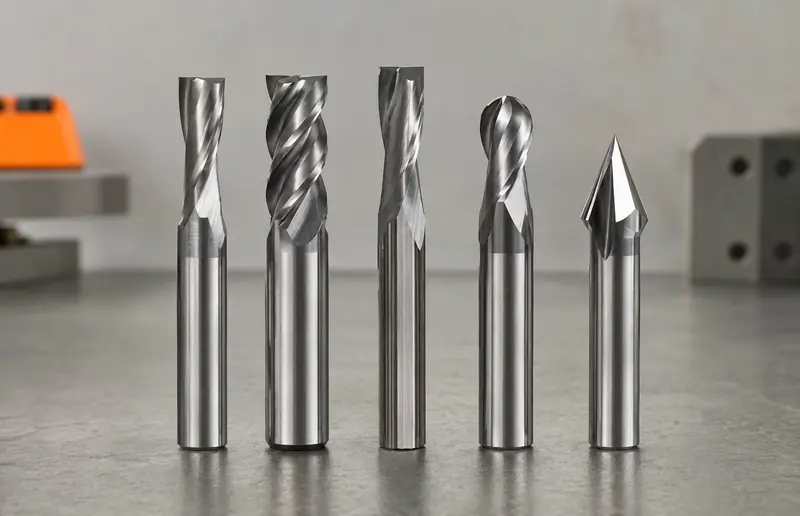
A wood router bit should not be selected by profile alone. Machine type, shank diameter, workpiece material, cutting depth, chip direction and the required finish determine whether a bit is genuinely suitable. A bit that is appropriate for a handheld router may not be approved for a shaper, and a geometry that performs well in solid wood may wear quickly in abrasive MDF.
Main types of router bits for wood
| Router-bit family | Common operations | Critical check |
|---|---|---|
| Straight or spiral | Grooves, pockets and cutouts | Plunge capability and chip evacuation |
| Flush-trim or pattern | Templates, duplication and trimming | Bearing position and cutting height |
| Edge-forming | Roundovers, coves, chamfers and ogees | Profile dimensions and pass depth |
| Joinery | Rabbets, tongue-and-groove and matched joints | Actual stock thickness and height setting |
| Dovetail | Drawers, slides and interlocking joints | Angle, diameter and jig compatibility |
| Surfacing or spoilboard | CNC spoilboards, slabs and tabletops | Approved diameter, rigidity and stepover |
| V-groove and engraving | Lettering, signs and decorative grooves | Included angle and effective depth |
What each router-bit type does
1. Straight and spiral router bits
Straight bits are used for grooves, rabbets, pockets and some cutouts. A conventional straight bit has cutting edges that run broadly parallel to its axis. A spiral bit uses helical flutes that influence chip evacuation and the finish on the workpiece faces.
An upcut spiral generally pulls chips upward and improves evacuation, but it can lift fibres on the top face. A downcut spiral pushes toward the top surface, which can protect that face while increasing the risk of trapped chips in a deep groove. A compression bit combines both directions to target clean top and bottom faces when its transition zone sits correctly within the material. See the detailed guide to upcut, downcut and compression bits.
2. Flush-trim and pattern bits
The bearing follows a template or reference surface while the cutting edges reproduce its contour. Depending on the model, the bearing may be near the shank, at the tip or at both ends. Its position determines where the template must sit and how the work is presented.
Confirm that the bearing remains in contact with the template, that the cutting height covers the work without forcing a non-cutting section into it, and that the shank exactly matches the collet. A bearing cannot compensate for a loose template or poorly secured stock.
3. Edge-forming bits
Roundover, cove, chamfer, ogee and other decorative bits primarily shape edges. The visual name is not enough for selection: check the radius or angle, maximum diameter, complete profile depth and whether a bearing is fitted.
A large profile removes substantial material. Progressive passes reduce load, burning and tear-out. For a consistent edge, the reference face must stay stable against the router base, table or fence throughout the cut.
4. Joinery bits
This family includes rabbeting bits, tongue-and-groove sets, matched profile sets and cutters for doors or panels. They create a mechanical joint; they do not automatically make that joint invisible or strong enough for a particular load.
Measure actual panel thickness rather than relying on its nominal size. Make a test joint from both mating pieces, mark the reference faces and adjust one setting at a time. On a router table, use suitable fences, hold-downs, guards and feeding methods.
5. Dovetail bits
Dovetail bits are used for drawers, boxes, sliding dovetails and decorative or structural joints. The fit depends on cutter diameter, included angle, depth and, when a jig is involved, the guide bushing and jig spacing.
Two bits with the same nominal angle are not necessarily interchangeable. A small change in diameter or cutting length can alter the joint completely. Use the cutter specified by the jig manufacturer or make controlled trials before machining the final parts.
6. Surfacing and spoilboard bits
A surfacing bit uses a relatively large diameter to flatten a CNC spoilboard, tabletop or slab. Indexable versions allow worn edges to be replaced, but cutter mass and diameter make spindle power, collet or holder compatibility and rated maximum speed essential checks.
The machine must be rigid and the spindle properly trammed. A spindle that is not square to the working plane can leave ridges or repeating marks. Use a shallow depth, consistent stepover and effective extraction, especially when machining MDF.
7. V-groove and engraving bits
V-bits are used for engraving, signs, decorative grooves and some chamfers. Cut width changes with the cutter angle and depth, so a small height variation can visibly change the result.
Check the included angle, tip diameter, runout and surface flatness. For consistent engraving on an uneven panel, surface preparation and toolpath strategy matter as much as the cutter.
Handheld router, router table, CNC or shaper?
- Handheld router: the bit is clamped in a collet and the base moves over the work. Control, feed direction and stock stability are critical.
- Router table: the router is inverted below a table. Fence, hold-downs, guard and stock presentation must suit the profile.
- CNC router: motion is programmed. Tool stickout, holder, machine rigidity, extraction and CAM strategy affect the result.
- Shaper or spindle moulder: it commonly uses dedicated arbors and cutterheads. A shank-type router bit is not automatically an approved shaper cutter.
HSS, carbide and polycrystalline diamond
Cutter material is not selected from wood hardness alone. Heat, abrasion, cutting speed, rigidity, expected production and cost all matter.
- High-speed steel (HSS): tough and resharpenable for certain profiles and applications, but generally less resistant to abrasive wear.
- Carbide-tipped: carbide edges are brazed to a steel body. This construction is common for many profiling bits.
- Solid carbide: common in smaller CNC spiral bits; it offers good wear resistance but is less tolerant of impact and excessive runout.
- Indexable carbide: replaceable edges are practical for surfacing and some production work when inserts are seated and tightened correctly.
- PCD: polycrystalline diamond is intended for specific high-volume abrasive applications, including some panels and composites. Its cost and specialist servicing are not justified for every shop.
A practical router-bit selection workflow
- Identify the machine: collet, accepted shank sizes, speed range, power and manufacturer limits.
- Define the operation: through-cut, groove, pocket, edge profile, joint, template work, engraving or surfacing.
- Name the material: solid wood, plywood, MDF, melamine and composites wear and chip differently.
- Measure the job: diameter, depth, radius, angle, stock thickness and required cutting length.
- Select geometry: spiral direction, flute count, bearing position, profile and plunge capability.
- Validate limits: rated maximum RPM, pass depth, feed and both machine and cutter manufacturer instructions.
- Test on scrap: observe chips, sound, temperature, vibration and both workpiece faces.
For currently supported families, begin with the MatchMyTools selector, then confirm the exact part number against manufacturer documentation.
Safety checks before routing
- Disconnect or lock out the machine before changing a bit.
- Clean the shank and collet; never clamp an incorrect shank diameter.
- Respect minimum insertion depth and keep stickout only as long as necessary.
- Inspect the cutting edges, bearing and hardware, and verify rated maximum speed.
- Secure the stock and template, and keep guards and extraction in service.
- Wear suitable protection and stay out of the cutter’s potential projection plane.
- Stop for unusual vibration, smoke, heat or sound.
Frequently asked questions
Can a straight router bit cut completely through a panel?
Only when its geometry permits the planned entry, its cutting length exceeds the real depth and the machine, evacuation and pass strategy are compatible. Not every straight bit is designed to plunge vertically.
Which bit can produce clean top and bottom faces?
A compression bit is often considered for veneered or laminated panels, but it works correctly only when the upcut/downcut transition is inside the stock. The wrong depth can produce a worse result than a single-direction spiral.
Is carbide mandatory for MDF?
Not in an absolute sense, but MDF is abrasive and carbide generally retains its edge longer. Production volume, geometry and manufacturer guidance should decide the final choice.
Technical sources
- Amana Tool — Straight plunge router bit specifications
- Amana Tool — Flush-trim and template routing
- Freud Tools — Router and CNC bit families
- OSHA — Handheld router hazards and controls
- OSHA — Router guarding, tool holding and maximum speed
The stated parameters are starting points. Test progressively on scrap and always respect manufacturer limits.